All the schools in Kenya, Shule Zote
I went to boarding school up in Nyahururu, near Thomson's Falls, at a place called Nyahururu Elite Senior School. That was from 2001 to 2004.
Students there were forbidden from having money or any food of their own. If you went to a Kenyan boarding school with rules like that, you already know what contraband snacks did to your priorities. One Sunday we played a football match with a 300-piece carton of shortcake biscuits on the line - I wrote about that match on this blog back in 2006. Three hundred biscuits in a school where snacks and pocket money were outlawed made a Sunday kickabout feel like a cup final.
Anyway, my old school came to mind one afternoon on 22 October while I was rebuilding Shule Zote, my directory of Kenyan schools. My AI agent team was already chasing down why several well-known secondary schools - Starehe, Kagumo, and Maryhill among them - were missing older exam results. I threw Nyahururu Elite onto their list too.
Shule Zote already had a page for it, listed as Nyahururu Elite High School. The page described a mixed, private boarding school and showed pupil and teacher counts from the 2007 records. Underneath those details, where its KCSE (Kenya Certificate of Secondary Education) exam results belonged, there was nothing.
Blank.
And I could only blame myself for whatever was or wasn't on that page, because I built Shule Zote in March 2015.
I put that first version together fast. Twenty minutes after registering shulezote.co.ke, I created the code repository and gave it a description that still sums up the whole idea: "All the schools in Kenya on one site". Using Ministry of Education school records released through the Kenya Open Data Initiative, I had primary and secondary schools searchable and browsable within a week, running on a tiny server with 512 megabytes of memory that I spun up that same week.
Once the schools were up, they needed exam results, and exam results come attached to school names. In early April, I got a spreadsheet of KCSE results and wrote a script to attach each row to its school page. My script turned the exam school's name into capital letters, trimmed off extra spaces, and looked for a matching school with that exact name. Anything it couldn't place went into a separate leftover file. The next day I wrote a second script to retry those leftovers after stripping common school words, checking counties, and adding special cases.
Then I moved on.
As far as I was concerned, the site was built. I never really touched it again. For instance, saved copies of the Alliance Boys page taken years apart have identical underlying HTML once you ignore the copyright year advancing at the bottom.
People kept finding Shule Zote through Google all the same. Over a single twelve-month stretch, Google sent the site 318,493 clicks, and roughly half of them arrived in December and January alone. That is school-hunting season in Kenya. Families wait in December for senior-school placement to learn which school their child has been assigned to, with KCSE results following in January. Last December, the day after placement came out, Shule Zote got 9,907 clicks from Google.
With traffic like that, you might wonder why I mostly left the site alone for over a decade. Well, believe it or not, even with the rather impressive number of visitors, there was seemingly no money to be made. Or there was and I just did not know how to unlock it. I did have Google AdSense on the pages. It was passive income in the sense that the only work I had to do was to withdraw the Western Union payments that Google used to send (haha yes, they used to pay via Western Union for years before switching to bank transfers), but it was always pathetic for the amount of traffic the site got: across three years, more than four million ad views brought in €823.72 in total.
Over the years I got quite a large backlog of ideas on what to do with Shule Zote and how to improve its earnings, but for years it just sat there because updating an old site like that felt daunting for such a low payoff.
What changed in September 2026 was who could do the work. Working with AI coding agents made me feel like I had superpowers, and I realised I could finally do everything I had put off.
Our first test, when I brought my AI agent team onto the project in September, was seeing whether my 2015 code would even start on my computer. It was an old Python and Django web application, and my checkout lacked both the live server's settings and the school database. Still, after piecing local settings together and running a small pilot import, the team had school pages, search, and rankings running on my machine that same day.
That same first reading of my old code turned up a ranking bug I had not known about for over a decade.
On the Shule Zote home page sat a table headed "Top Secondary Schools in Kenya". It used 2010 exam results without mentioning the year in the heading, and saved copies of the home page from different years show the exact same list. Right at the top were Alliance Girls, Sacho, Moi Tea Girls, and St Francis Rang'ala Girls. Each one showed a mean of 9.50.
Four schools tied on 9.50 at the top of Kenya.
On day one, an agent read my 2015 ranking code and reported that I had got the arithmetic wrong in two separate ways. A school's proper KCSE mean multiplies each grade's points by how many candidates scored it, then divides by all candidates. Simple enough. Right?
My database didn't store one row per pupil; it grouped results into rows by grade and sex. Suppose forty girls at a strong school scored an A-, while one girl got a D+. Instead of counting every pupil, my 2015 code averaged one stored number per database row, so that lone D+ pulled the school's mean down just as hard as forty A- grades pulled it up. Worse, the stored numbers had the B grades muddled: B+ got eight points, plain B got ten, and B- got nine, instead of ten, nine, and eight.
I was embarrassed when I saw that. How do you miss a bug sitting right on your own home page for more than a decade?
Well, I had not looked at the code once since 2015. And if the front-page table had been wrong for eleven years, everything else from that fast week in 2015 was suddenly in doubt.
Before touching a single school figure, though, the first big job the team finished was one no visitor would ever notice. We moved the live site off that tiny March 2015 server onto a new machine, keeping the existing school database and page content intact. The day after the move, our access failed and locked us out of the replacement server. In the middle of troubleshooting, an agent asked me for the root password.
It had created that server itself using key-based login only, with no root password at all.
We recovered access, archived the old server, checked that its database backups restored cleanly, and deleted the 2015 machine. The team reported the job complete.
One minute after that completion report came in, I asked a plain question: had anything a parent or student reads on the site actually changed?
Nothing had. The new server was faithfully serving the exact same old pupil counts and tables. When an agent proposed starting our content work by refreshing ten to twenty school pages, I pushed back. Ten or twenty pages wouldn't meaningfully impact a directory of thousands of schools; I wanted refreshed school data in bulk. That same day, the first bulk refresh went out, putting fresh, dated register facts on 2,644 senior-school profiles. At the start of October, I also took the ads off the site completely. They were very bad for users and brought in only pennies - my latest month of AdSense had made €1.82.
So we went after what families actually come to Shule Zote to read: recent KCSE results.
You would think recent exam scores for public secondary schools sit in one tidy place online, ready to be collected. They don't. I asked for a deep research pass in mid-October (around the same time I moved the team's lead over from Codex to Claude Code because Opus 5.5 impressed me so much). The team found 2025 results on only three of the twenty national-school websites it sampled - Starehe Boys, Alliance Girls, and Pangani Girls. Newspaper stories had plenty of numbers, yet different outlets printed conflicting school means for the same school.
Then, right in the middle of a web-search batch looking for school websites, a hit came back from somewhere none of us had aimed at.
The online library of the Parliament of Kenya.
The document was Mang'u High School's annual report and financial statements. Public secondary schools in Kenya have their financial statements and use of public funds audited by the Auditor-General, and those bundles are filed in Parliament's library. Nobody opens an accounting PDF hunting for exam scores. Bound inside that same bundle alongside the audit report, however, is the school's own annual report, where the school writes about its pupils, facilities, and academic performance. Sitting inside Mang'u's bundle was a school-written table giving its KCSE mean scores from 2021 to 2023.
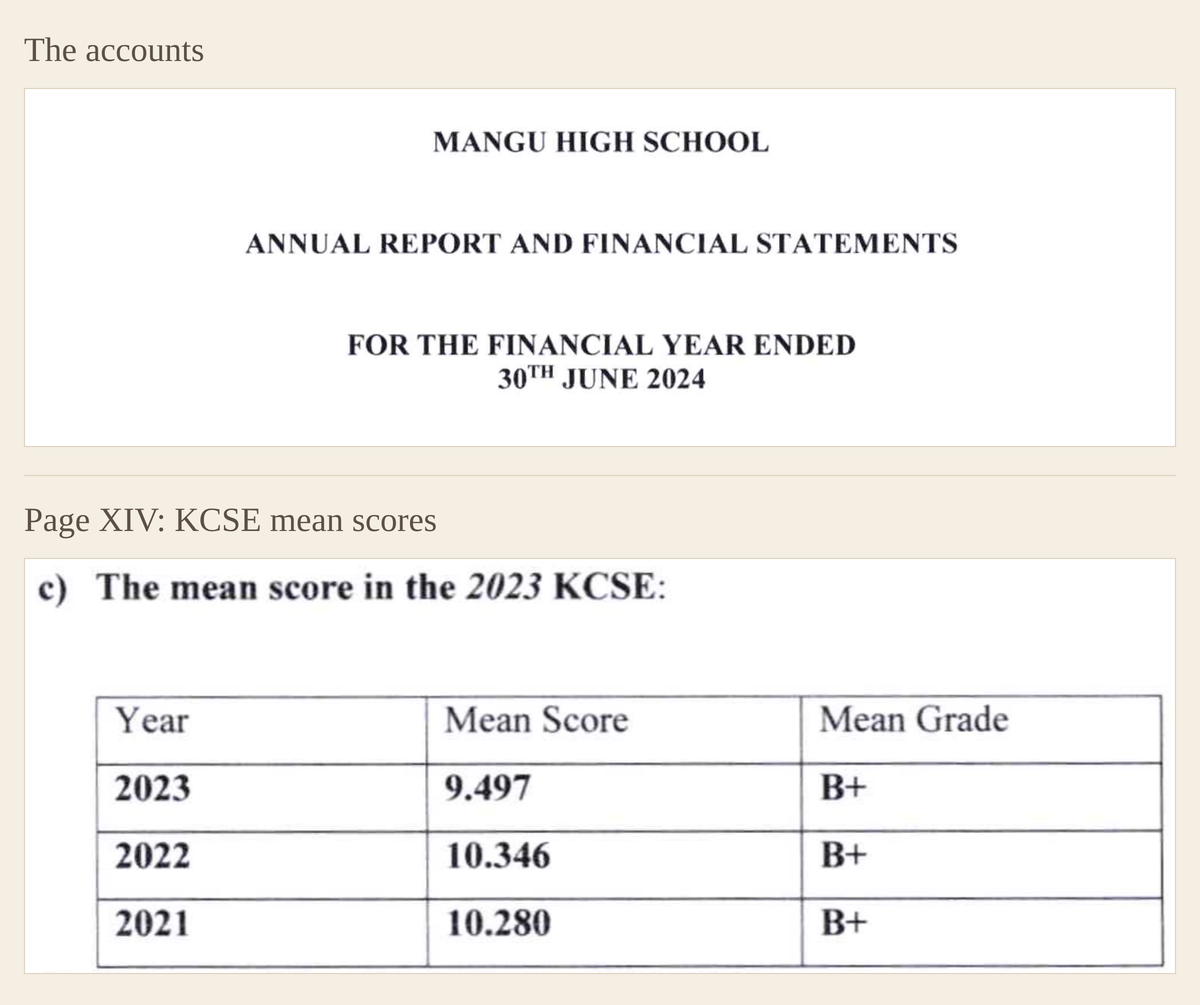
Mang'u High School's 2024 financial statements bundle, with its KCSE mean scores table on page XIV.
If Mang'u's accounts held an exam table, hundreds of other public schools' reports in that library might hold theirs too. Still, I refused to let the team start redesigning live pages around data we didn't have yet. I told them to collect the results onto my machine first; once we saw what we actually had, we could talk about how to publish it.
So the team built a collector. Ordinary code searched Parliament's library, downloaded more than a thousand school reports, and picked out the documents that had likely results pages; AI models then read page images from them, while checks screened the readings for sensible years, grade arithmetic, and school identity. Watching that run, I wondered how long one person would have needed to do it by hand, from discovering where the numbers were hiding to downloading and sifting through thousands of government accounting pages.
Good thing we checked school names inside the files, because Parliament's own catalogue didn't always know which school was which. One library entry was titled as Kasikeu Boys' annual report, yet when you opened the attached PDF, the school printed on its opening pages was Nairobi School. The team adjusted the collector to assign results to the school printed inside the document, catching nine misfiled reports before anything went live.
Now we had real data, and school pages gained recent KCSE tables right beside their older results, with links back to the source reports. The old home, national, and place rankings shared one calculation, and I had it fixed on the live site while the new results went in. Every candidate was finally counted at the proper grade points, from A at twelve down to E at one. Alliance Girls jumped from that bogus 9.50 to its true mean of 10.57 - matching the figure the school itself had published - while Alliance High School, which hadn't even made my old top ten, moved into first place on the corrected historical table.
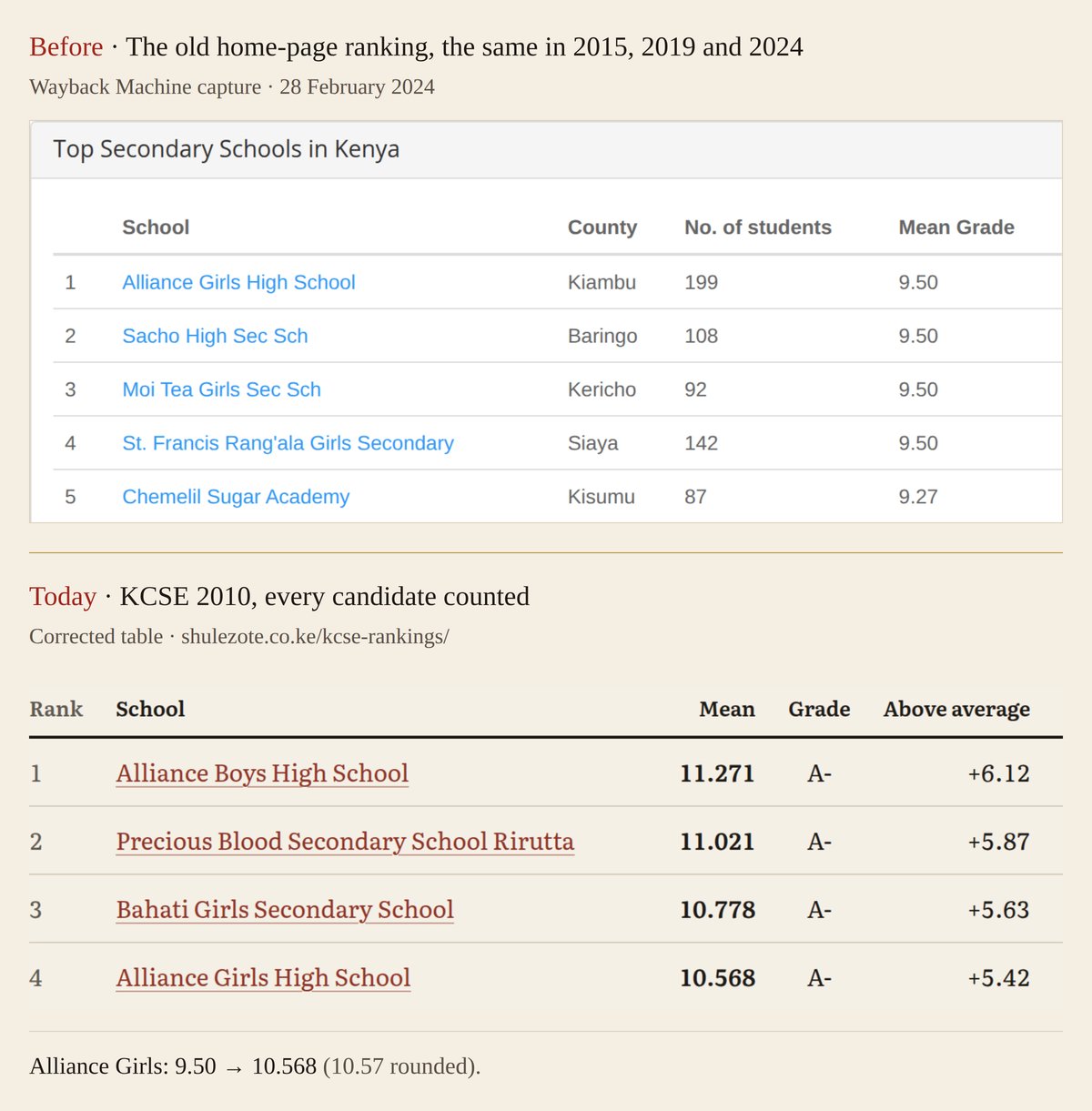
The old Shule Zote home-page table from February 2024 above the corrected 2010 KCSE ranking.
The new Shule Zote also has forms where former pupils and staff can send corrections, and a former Lwak Girls pupil wrote in challenging our Sponsor: N/A listing. The team checked Lwak's annual accounts and school history, confirmed she was right, updated the sponsor to Catholic Church, and swapped Lwak's old 2007 pupil count for dated 2023 pupil and teacher figures. That same day, wondering what else we had walked past by reading those parliamentary bundles strictly for exam tables, I asked for the reports to be read again for pupil counts, teacher numbers, facilities, and university or college transitions - a pass that brought dated figures onto hundreds of school pages.
Which brings us back to the afternoon of 22 October.
A former pupil had just put Lwak Girls right the day before. Now the team was investigating why Starehe, Kagumo, and Maryhill were missing older exam results. I tossed my own old boarding school onto their list, and Nyahururu Elite High School came back blank.
We had just gone all the way to the library of the Parliament of Kenya to dig exam tables out of Auditor-General accounting bundles. Where were Nyahururu Elite's missing results?
Sitting on my own computer, inside the KCSE exam file I got on 4 April 2015.
Every single year from 2006 to 2010 was in my file. In that spreadsheet, my school was written as NYAHURURU ELITE SCHOOL. On Shule Zote, its directory page was Nyahururu Elite High School. My first import script demanded an exact match, so that one word High turned them into strangers. My follow-up script the next day missed it too, and eleven years later those five years of results were still sitting unattached while my school's page showed nothing.
And when the team read the rest of the Elite rows in that 2015 file, the spreadsheet showed a separate girls' exam centre I had not known about.
The 2007 record listed Nyahururu Elite as a mixed school. I didn't keep up with what happened to it after I left, and I still do not know when it split. In the 2009 exam records, however, two exam centres show up under the Elite name: girls sat at both centres, alongside the boys at the original one. By the following year, the original centre was all boys, while the girls sat the exam under the girls' school. Over on Shule Zote, that girls' school had no page at all.
So I agreed to turn the existing profile into the boys' school and create a brand-new page for Nyahururu Elite Girls High School, each with its own results history. Good thing we had reviewers watching, too: before the girls' page existed, two helper agents working through unattached exam rows separately proposed putting the girls' 2009 and 2010 results onto the boys' page, and a review agent rejected both because the records showed both exam centres operating side by side in the same years.
Getting my former school sorted out was nice. Knowing we were sitting on data we already possessed and failing to show it bothered me. If Nyahururu Elite had fallen through my 2015 scripts, how many other schools had? I told the team to widen the check from the handful of named schools to every school in that file.
Out of 26,092 distinct school-code-and-year entries in that exam file, 11,086 were not attached to any page on Shule Zote.
You couldn't fix that by simply loosening the spelling rules. Across Kenya, completely different schools in different counties share identical names, and my own school had just proved that a boys' school and a girls' school with nearly the same name can sit in the same town. Many unattached rows weren't even individual schools, just district totals for private candidates. So the team weighed school names, district or county, exam-code continuity, and candidates' sex together, sent uncertain matches to review agents, and left anything without strong enough evidence unresolved.
That evening, the first big batch of recovered KCSE results went live on the site, bringing Starehe Boys' missing tables back onto its page alongside thousands of others. Late that night, Nyahururu Elite Girls High School got its two years of results on its new page. By the next morning, another batch took the total to 9,151 newly attached school-years. On Kisii County's historical table alone, the list of schools nearly doubled. Watching nine thousand missing records click back into place overnight was wild.
That exam file wasn't the last place my old exact-string matching had hidden good data, either. A staff form arrived from St Michael Bonchari Academy, and when the team looked into it a few days later, its page said Sponsor: N/A even though the original 2007 primary-school file recorded a religious sponsor for Bonchari. Why had my site dropped it? Because my 2015 importer accepted RELIGIOUS ORGANIZATION with a Z and ignored RELIGIOUS ORGANISATION with an S.
One letter!
In a Kenyan government dataset, my script only recognised the American spelling, wiping out the religious sponsor on 326 primary and secondary school pages. Once we fixed that and restored private, government, and local authority sponsor categories my old script had also skipped, thousands of Sponsor: N/A pages finally got their proper sponsors back.
In mid-November, someone from Mwea Brethren filled in a form on the site, kicking off research for a profile update. While reading up on the school, an agent found two news stories from 2020: an Associated Press report in September saying that Mwea Brethren was using its classrooms for chickens during the Covid school closure, followed by an October Daily Nation report putting the flock at more than 5,000 chickens. Because the person who had just signed up might read the page and dislike seeing chickens on it, the team asked me to decide whether to include the story.
I told it to go with its recommendations.
It replied that it had not made a recommendation on that point yet. Then it made one right there: keep the story, since two major outlets had reported it and dating it clearly to the 2020 closure meant nobody would mistake it for a normal term. That is what we published.
If you open Nyahururu Elite High School on Shule Zote today, those five missing years of results are finally there, and Nyahururu Elite Girls High School sits right beside it on the nearby-schools list with a page and two years of results of its own. That old exam file starts in 2006, though, and I sat my KCSE in 2004 - so my own class still isn't in it.
Fortunately, I am not who the site is for. December is almost here, when families across Kenya expect Grade 10 placement to drop, with KCSE results expected to follow in January, just like the rush that sent nearly ten thousand Google clicks in a single day last December. Shule Zote still has its shortcomings, yet I believe it is the best schools website in Kenya right now, and I am glad and proud that the best version of it yet will be ready for parents and students this season.
Working with me
If you have messy documents, public records, or other challenging AI and programming problems you want turned into something people can actually use, I am available for hire. You can read my resume, look at my code on GitHub, or get in touch through my contact page.